The Future of the App Market
A recent article from TechCrunch argues that the mobile app market is approaching maturity, as overall growth of the industry is slowing. Aggregate data recently published by Flurry shows a sort-of cannibalistic phenomena within the industry itself, where some app categories are growing at the expense of others. This, argues Sarah Perez, author of the aforementioned Techcrunch article, is because of one simple limiting factor: user time. Her analysis of the Flurry data and explanation for the push behind this cannibalization trend is adept; users are now often forced to choose between two apps, instead of using them both, because of time constraints placed on them by their busy schedules. I feel, though, that Perez failed to mention a clear pattern arising within the industry that is also indicated by this data.
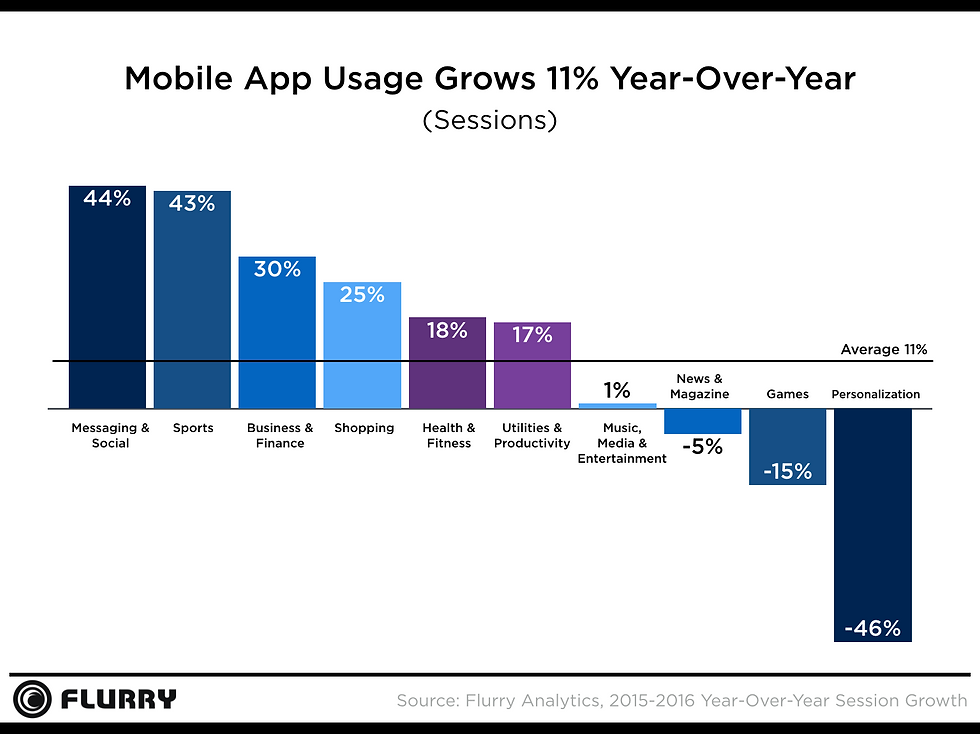
A close analysis of what app categories are growing, and which are shrinking, reveals the foreshadowing of a broader transition taking place in the mobile user’s mindset. Mobile users are beginning to see their devices as a tool for productivity rather than a source of entertainment. Looking at growth trends -- and setting aside the always-growing category of social messaging -- apps in the Business & Finance, Shopping, Health & Fitness, and Utilities & Productivity realm are experiencing the most growth (30%, 25%, 18% and 17%, respectively). This trend shows a broader movement that is the result of the summation of small changes in user behavior. Individuals are now using their phones on the subway during their morning commute to track their steps, order laundry detergent, or budget their money. During downtime, less people are launching gaming apps or digital news platforms (growth of which is down 15% and 5%, respectively). Instead, the busy working man or woman takes the five minutes of time they have do have on the subway to get something done, or check something off of their list.

So what does this mean for apps with platforms centered around entertainment? Well, as long as game companies and news outlets are forward thinking and willing to adapt, they need not worry. Up until this point, I have pushed aside the messaging & social app category that has proven itself, time and time again, to be a category with steady growth. Apps with interfaces that allow for social conversation and networking continue to entice users to join, stay and spread. This idea is not the least bit substantiated by the observed 44% growth the category experienced in the last year or so, and again supported by the fact that user time spent on apps in the messaging and social category increased 394% in 2016. In order for gaming and news outlet apps to stay relevant in a fiercely competitive and saturated market where users are inclined to use apps that make them feel productive, entertainment app companies must begin to view their platforms as a social space where users can interact with friends and an online community. Because reading and gaming are traditionally thought of as hobbies or free-time activities, apps in these categories must fight to redefine their mission to include communication and connection in order to keep users onboard. Adding this aspect to their platform will allow apps in that realm to experience the same growth that messaging & social apps enjoy.
In all, data from Flurry shows that a shift is occurring among mobile app users in terms of benefit sought. Behind us are the days of associating mobile devices mainly with gaming and entertainment. Now, the industry and its players must adapt in one of two ways. In the little pockets of free time that busy mobile users find throughout their day, they prioritize productivity and communication; adapting app platforms to satisfy these desires will ensure long term success for the companies that develop them.


Comments